

The Best Exercise Plan After 50 Might Be Easier Than You Think

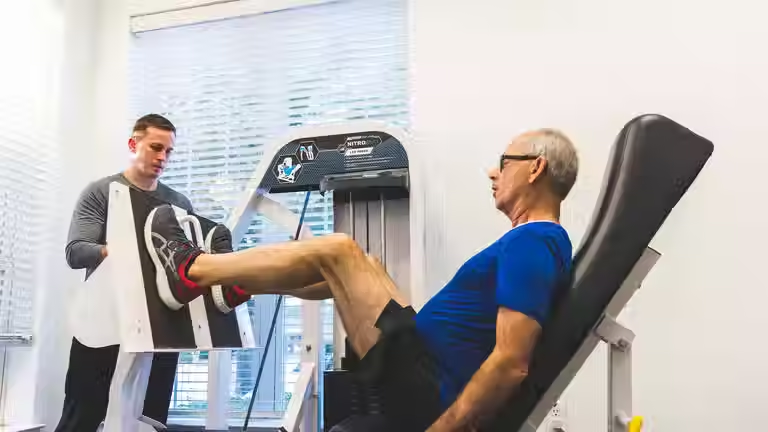
If you've ever looked at a gym and thought, "There's no way I have time for all that," you're not alone.
For years, the fitness world has told us that building muscle requires long workouts, heavy weights, and multiple trips to the gym every week. While that may be true for bodybuilders and elite athletes, new research suggests something encouraging for the rest of us: you don't need the perfect workout program to get most of the benefits.
In fact, when it comes to healthy aging, the best exercise plan may simply be the one you'll actually do.
A recent analysis highlighted by reviewing 192 studies on resistance training in adults who were not highly trained athletes. The goal was simple: determine the minimum amount of strength training needed to achieve meaningful improvements in strength, muscle mass, and mobility.
The findings were surprisingly good news.
Researchers found that people who performed resistance training just twice per week, using moderate weights for multiple sets, gained roughly 75% of the strength benefits seen in more advanced programs. Even more impressive, they achieved nearly all of the muscle-building benefits and the full mobility improvements associated with more demanding training routines.
In other words, you don't need to train like a professional athlete to experience major health benefits.
Why does this matter so much after 50?
Because muscle is one of the most important predictors of healthy aging. As we get older, we naturally lose muscle mass in a process known as sarcopenia. This loss contributes to weakness, poor balance, reduced mobility, increased fall risk, and loss of independence.
Muscle isn't just about looking fit. It's your body's reserve tank during illness, injury, and stress.
The researchers identified what could be called a "minimum effective dose" for resistance training:
Two sessions per week
Moderate weights that allow about 8–12 repetitions
Three to four sets per exercise
Focus on major compound movements
Effort that feels challenging, but not all-out
That's it.
No marathon gym sessions. No lifting maximum weights. No complicated workout spreadsheets.
The real lesson from this research isn't about exercise science—it's about consistency.
Many people never start strength training because they believe they need the perfect program. Others quit because the program is too demanding. But a simpler approach that you can maintain for years will almost always outperform an "optimal" plan that lasts only a few weeks.
The goal isn't perfection.
The goal is building enough strength, muscle, and mobility to continue doing the things you love for decades to come.
After all, the best workout program isn't the most advanced one. It's the one you'll still be doing next year.
Want more simple, science-backed strategies to improve strength, mobility, energy, and longevity after 50? Subscribe to 10-Minute Longevity and get practical healthy aging insights delivered straight to your inbox each week.


Comments